The story is worth reading twice
On September 9, Odoo published the story of S[&]T, a services firm that doubled its operations on Odoo. Strip the promotional language and look at what the story actually credits for the outcome. Per Odoo's own writeup, the project's stated goal was to "use standard Odoo features as much as possible, keeping customization to a minimum", with "strong involvement from S[&]T's key users and management" throughout.
The reported results: everything centralized on one integrated platform, financial planning that became reliable and timely, workflows automated to the point that manual data entry disappeared, and the headline number: the business doubled while the admin team stayed almost exactly the same size.
That last line is the entire economics of ERP in one sentence, and we'll come back to it. But first, notice that the method got equal billing with the results. That's unusual for marketing, and it's the leak worth collecting.
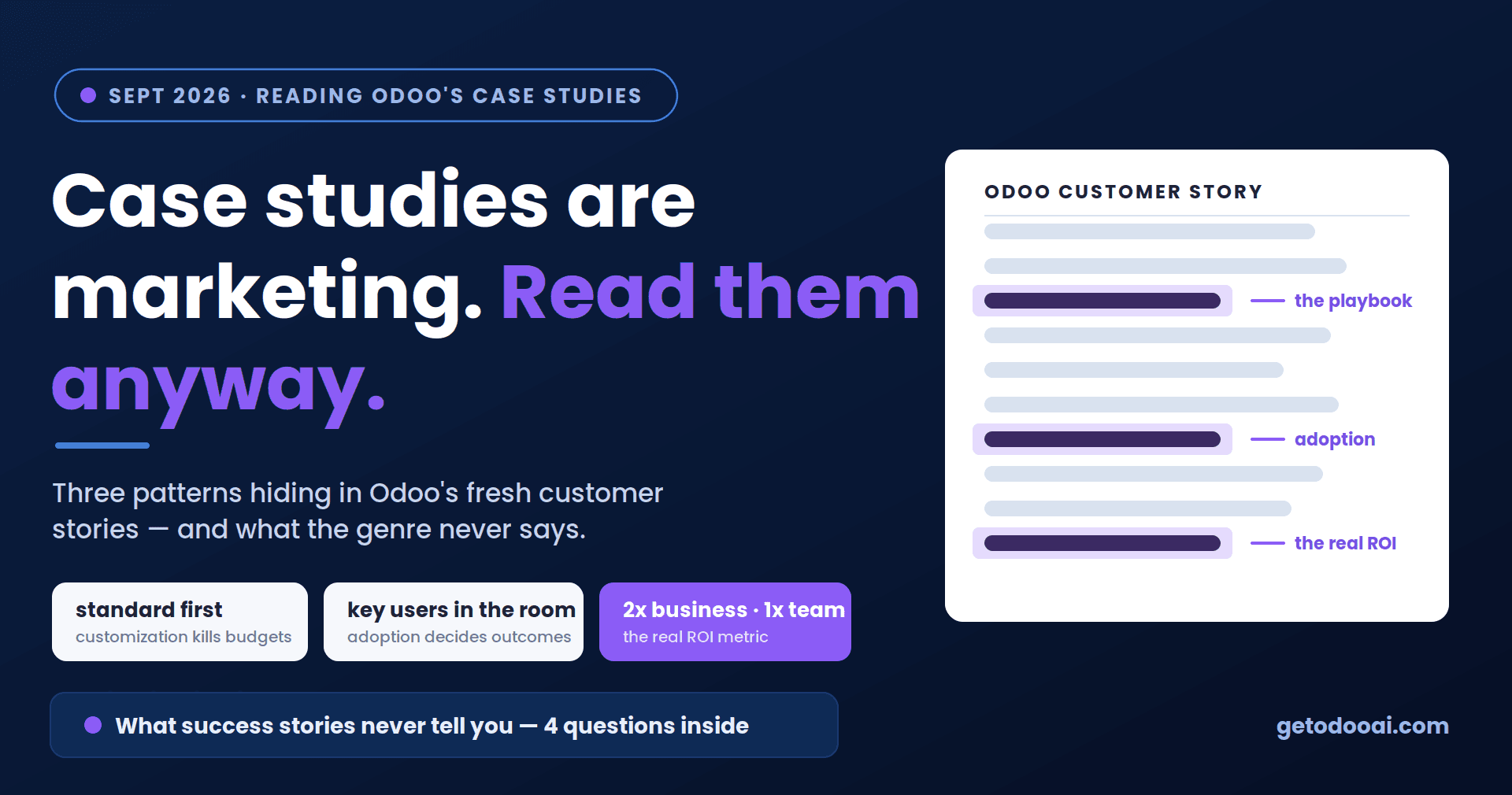
Pattern 1: The winners stay standard
"Standard first, customize last" appears in Odoo's success stories for a simple reason: it's the strongest predictor implementers know. Every customization you add is code you'll pay to build, pay to maintain, and pay again to drag through each version upgrade; the Odoo 20 transition will re-teach this lesson to every heavily customized install this year. Standard modules, by contrast, are maintained by Odoo, upgraded by Odoo, and documented for every new hire.
The uncomfortable corollary: when a business says "Odoo must adapt to exactly how we work today," they're often paying premium prices to preserve workflows that were themselves accidents of the old software's limitations. The disciplined question isn't "can Odoo do it our way?" (it usually can), it's "is our way worth its carrying cost?" The doubled-operations firm answered that question with restraint, and the restraint shows up in the result.
Pattern 2: Key users in the room, not at the finish line
The S[&]T story explicitly credits involvement from key users and management, and this too repeats across ERP literature because it's where projects actually live or die. An ERP delivered to a team fails quietly: people keep their spreadsheet shadow-systems, data goes stale, and eighteen months later "Odoo didn't work for us" enters the vocabulary. An ERP built with the people who'll run it- your best front-desk person, your inventory lead, your accountant- gets configured around reality and adopted by its co-authors.
Practical translation for your project plan: name your key users before you name your go-live date, and budget their hours like you budget the partner's. If your implementation quote doesn't ask for your people's time, that's not efficiency, that's a warning.
Pattern 3: The real ROI metric is growth without headcount
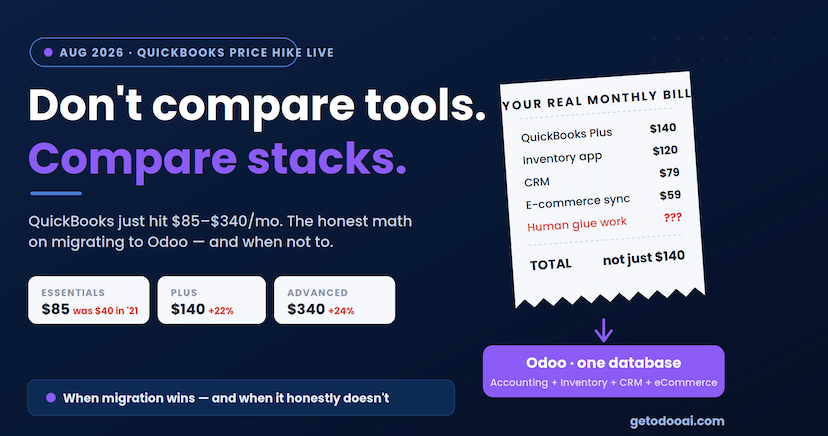
Notice what S[&]T's story doesn't lead with: software cost savings. The headline is operating leverage, double the business, same admin team. That's the honest metric for ERP, and it's exactly the math we walked through in our QuickBooks-to-Odoo analysis: when the customer record, the stock level, and the invoice are one object in one database instead of three synced copies, the re-typing, reconciliation spreadsheets, and duplicate-chasing that quietly consume admin payroll simply stop existing. The saved subscription fees are a rounding error next to the hires you don't have to make.
If you're building a business case for ERP, build it on this: what does your admin capacity cost per unit of business volume today, and what happens to that ratio when the glue work disappears?
The honest section: what success stories never tell you
We're an Odoo implementation partner; case studies are our genre too, so take this as an informed confession. Four things this format structurally omits:
- Timelines and budgets. "Implemented Odoo" might mean six weeks or fourteen months. The stories rarely say, because the honest answer ("it depends on your data and scope") doesn't market well.
- The messy middle. Every implementation has weeks where the old system is half-off, the new one is half-trusted, and someone's forecast lives in neither. Nobody photographs that part.
- Data migration pain. The single most underestimated line item: cleaning ten years of duplicate customers and creative chart-of-accounts decisions. It's absent from nearly every success story ever written, in any ERP.
- The failures. You're reading the survivors. Projects that stalled don't get blog posts, so the genre systematically overstates the base rate of success. Odoo's stories are real; the sampling is the marketing.
None of this makes the stories worthless; it defines their proper use. They're evidence of what's possible and how winners behaved, not a forecast of your project.
How to extract the missing parts (questions for any partner, including us)
- "Give me two reference customers I can actually call." Not quotes, phone calls. Ask those references about the messy middle specifically.
- "What was customized on your last three projects, and why?" A partner proud of how little they customized is showing you Pattern 1 in their own behavior.
- "What went wrong mid-project, and how did you handle it?" Instant answers mean experience; a blank means either dishonesty or no scars yet. Both are data.
- "What's your time-to-first-value?" Not full go-live, the date the first team stops using the old system happily. Good partners track this number.
The bottom line
The best way to read a case study isn't with belief or cynicism; it's with a highlighter, marking what the winners did. This month's batch highlights cleanly: stay standard, involve your people, measure leverage. Those three travel to any implementation, whatever partner you choose.