What is expense reimbursement, exactly?
An employee covers a business cost with their own money- the airport taxi, the emergency printer ink, the lunch where the deal closed- keeps the proof, and the company pays them back after checking the expense. Simple in concept. In practice, it's one of the most friction-filled processes in a small business, because it touches everyone: every employee who spends, every manager who approves, and the finance person who has to make the books agree with a shoebox of receipts.
Why do companies run it this way instead of handing out cash in advance? Three real reasons: field flexibility (urgent needs don't wait for a purchase order), cash security (money with documented proof beats cash floats that wander), and control: finance reviews every claim before company funds actually move.
How does the reimbursement process work?
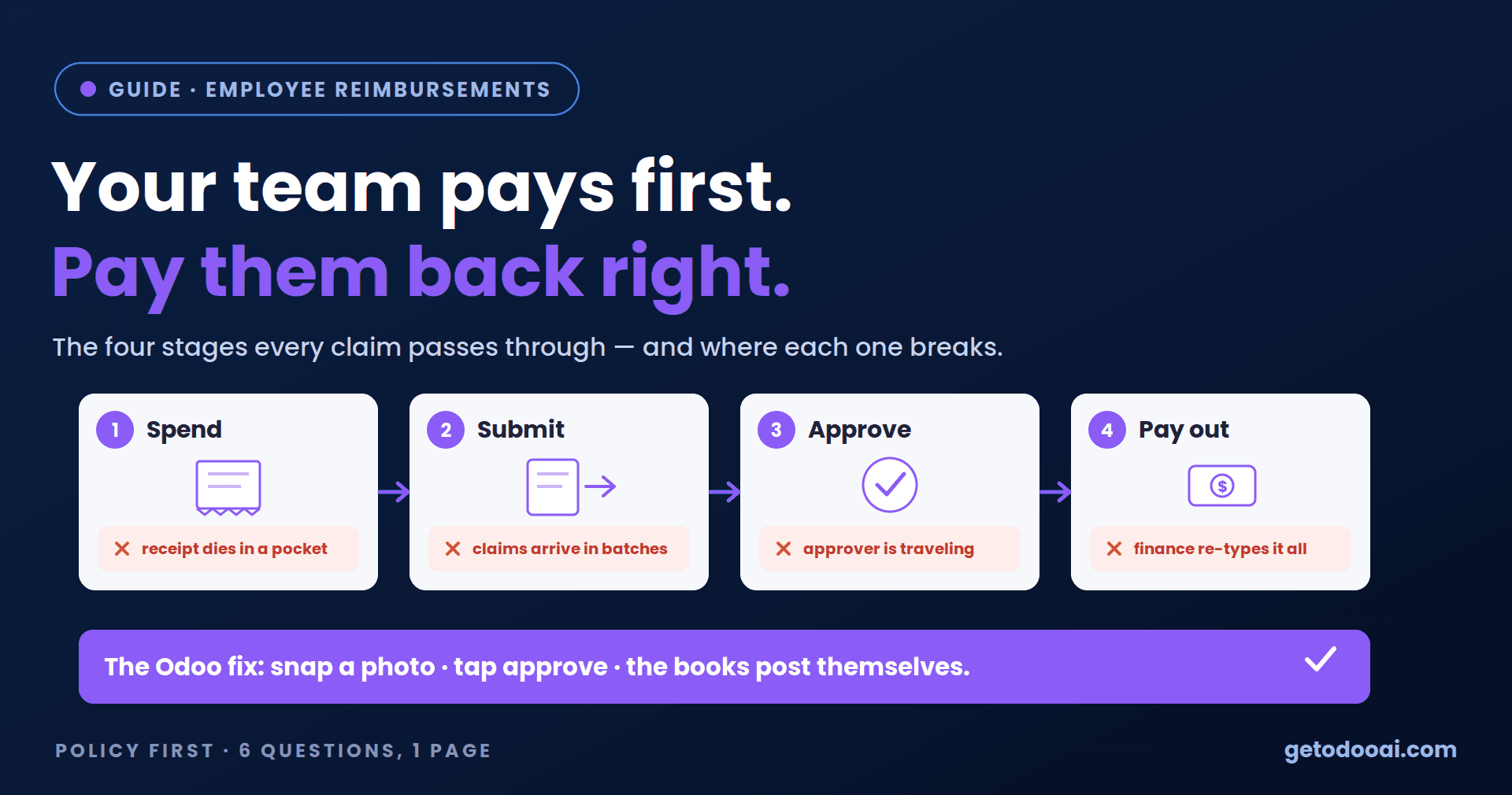
Every company's version is the same four stages wearing different clothes, and each stage has a signature way of failing. Knowing the failure is how you judge any fix.
Stage 1, Spend and keep proof. The employee pays and holds onto the receipt. Where it breaks: the receipt lives in a jacket pocket, a car door, or a phone gallery with 4,000 other photos. By month-end, a real percentage is simply gone, and so is the employee's money or your audit trail.
Stage 2, Submit the claim. A form (paper, spreadsheet, or app), receipt attached, sent to a manager or finance. Where it breaks: submission is annoying, so people batch it; six weeks of expenses arrive at once, out of budget period, right at closing time.
Stage 3, Approval. Someone checks: is this real, in policy, in budget? Where it breaks: the approver is traveling, the email sinks, and an employee who lent the company money waits three weeks for a click. Nothing corrodes goodwill faster.
Stage 4, Payout. Approved funds go out, bundled with payroll or as a separate transfer. Where it breaks: finance re-types every approved claim into the accounting system by hand. Duplicate entry, typos, and category guesswork, the quiet tax on the whole process.
Write the policy before you buy the software
Here's the step most guides, including most software marketing, skip entirely: a system automates your rules, so you need rules first.
A one-page reimbursement policy should answer six questions:
- What qualifies? Categories in, categories out (travel: yes; home office chairs: decide now, not per-argument).
- What are the limits? Per meal, per night, per category, numbers, not vibes.
- How fast must claims come in? A deadline (say, within 30 days of the expense) is what kills the six-week batch problem.
- What counts as proof? Itemized receipt vs. card statement; when a missing-receipt declaration is acceptable.
- Who approves what? Amounts under X: direct manager. Over X: finance. Over Y: owner. Write the matrix down.
- When do payouts happen? With payroll, weekly, or on approval- pick one and tell people.
One note for US businesses: ask your accountant about structuring this as an accountable plan; done correctly, reimbursements stay non-taxable for employees and clean for you. Ten minutes with your accountant now beats a painful conversation at tax time. (We implement software, not tax advice; that's your CPA's lane.)
What changes when reimbursement lives in your ERP
Now the system part. Odoo Expenses, the module we configure most often right after Accounting, rebuilds each stage around its failure point:
Receipts become photos, instantly. The employee snaps the receipt at the table; Odoo's AI reads the amount, date, and vendor and drafts the claim on the spot. Stage 1's "receipt in a jacket pocket" problem mostly stops existing, because capture happens at the moment of spending, not at month-end.
Approvals go mobile and visible. Managers see pending claims on their phone and approve or reject in a click; policies and limits are checked against the claim automatically. The traveling-approver bottleneck shrinks to the time it takes to look at a screen.
The books update themselves. This is the one finance teams love: on approval, the journal entries post to Odoo Accounting automatically, right category, right amount, no re-typing. Stage 4's duplicate-entry tax goes to zero, because the expense record and the accounting record are the same in the same database.
Everyone can see the status. Employees track their claim live: submitted, approved, paid, which quietly eliminates the "any update on my $300?" emails that nobody enjoys sending or receiving.
Payout fits your flow. Reimburse through Odoo Payroll with the next salary run or as a direct bank payment, and multi-currency is native- relevant if your team spends across borders, as many of our US–Pakistan–Middle East clients do.
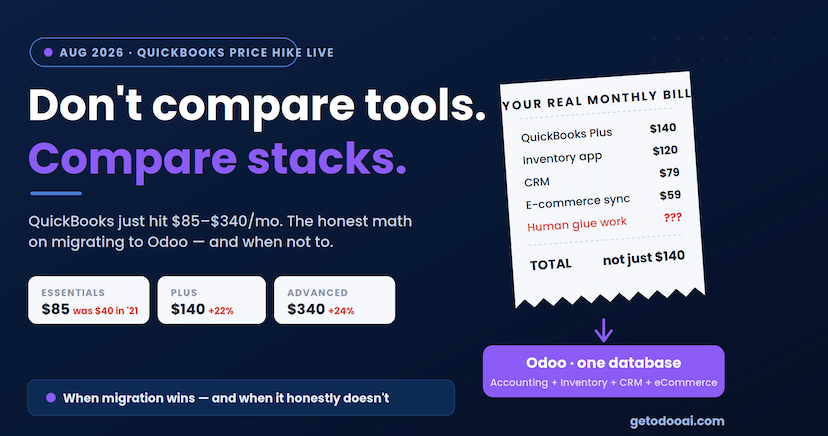
And the structural advantage over standalone expense apps: it's one module, not another subscription. A separate expense tool means another monthly bill, another login, and, the part that bites later, a sync to your accounting system that someone has to configure, monitor, and fix. Inside Odoo, there is no sync, because there's nothing to sync. That's the same consolidation math we walked through in our QuickBooks-to-Odoo analysis: the app stack's real cost is the seams between the apps.
When Odoo Expenses is not your answer
Two honest carve-outs, because recommending our hammer for every nail is how partners lose trust:
- You're not on Odoo, and you're not planning to be. Then a standalone expense app is a perfectly reasonable tool; just go in with eyes open about the subscription cost and the accounting sync you'll be maintaining.
- You want company-issued cards with built-in spend controls. Dedicated spend-management platforms issue physical and virtual corporate cards with real-time limits; that's their specialty, and Odoo doesn't issue cards. If eliminating out-of-pocket spending entirely is the goal, that's a different product category, and a legitimate one.
If you're already running (or moving to) Odoo for accounting, though, Expenses is close to a free win: same database, native integration, and setup measured in days, not months.
The bottom line
Reimbursement done badly taxes everyone quietly: employees float the company loans, managers drown in receipt emails, and finance re-types the whole mess into the books. Done right, it's a photo, a tap, and an automatic journal entry. The order of operations matters: write the one-page policy first, then put a system behind it, ideally the one already running your accounting.