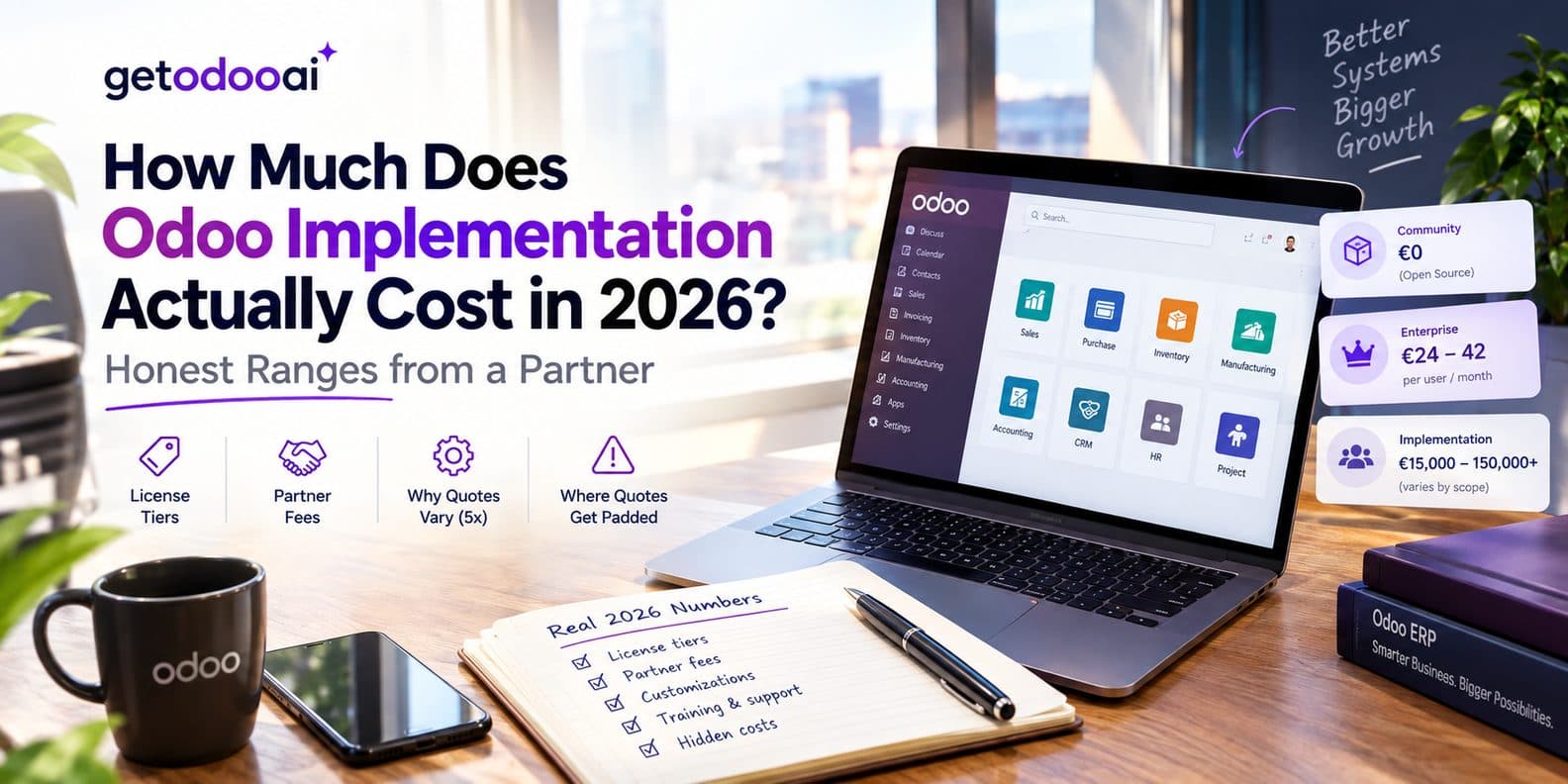
Why do three quotes for the same project differ by 5x
There's a scene every ERP buyer eventually lives. You send the same requirements to three partners and get back something like $14K, $38K, and $72K. Nobody explains the spread; everyone implies the others are either cutting corners or gouging.
Here's the unglamorous truth: the spread usually isn't dishonesty. It's that "the same project" doesn't exist yet. Each partner silently assumed a different answer to three questions, and those three questions are the price.
Driver 1: How much of Odoo will you fight?
Odoo ships with an enormous amount of working software. Configuration, setting up modules, workflows, roles, and automations using built-in tools, typically consumes 40–60% of a project's effort and requires no code. Studio-level changes (custom fields, form layouts, reports) cost hundreds to a few thousand dollars each. Custom module development is where budgets go to grow: $2,000–$30,000 per module, depending on complexity.
And here's the number that should be tattooed on every requirements document: in our experience, and every honest partner will tell you the same, a large share of custom-development requests are for things standard Odoo already does in a module the client hadn't explored. Every custom request should survive three questions first: can standard config do it? Can Studio? Can an existing community module? "We've always done it this way" is not a business requirement; it's a preference with a five-figure price tag.
Driver 2: How messy is your data?
Migration cost is a function of three things: how many source systems, how much data, and how dirty it is. A clean QuickBooks file moving into Odoo Accounting is routine; we do these migrations constantly, and they're predictable. Eleven years of contacts across four spreadsheets, two CRMs, and someone's email folder is an archaeology project, and it will be billed like one. The cheapest data-migration dollar you'll ever spend is the one spent cleaning your data before the migration, with your own team, who actually know which duplicates are real.
Driver 3: Who's doing the work, and from where?
Partner hourly rates vary several-fold by region for comparable Odoo certification levels. This is the driver vendors least like discussing, so we'll just discuss ours: GetOdooAI delivers with teams across the US, Pakistan, and the Middle East, senior architects and project leadership close to your timezone, and certified build capacity where rates are structurally lower. The blended rate is how our quotes land well under US-boutique pricing without the corner-cutting that pure-lowest-bidder outfits survive on. Every partner has a version of this math; the question is whether they'll show it to you. Ask.
Where quotes get padded (read this before you sign anything)
Since we're being honest: here's where the industry hides margin, ours included if you let it;
- Custom development quoted before standard features were checked. The single biggest source of inflated quotes. Demand the standard-first pass in writing.
- Vague line items. "ERP setup, $18,000" is not a scope; it's a vibe. Every line should name what's configured, migrated, built, or trained.
- No discovery deliverables. A "discovery phase" that produces no written workflow map, module plan, or data inventory is billable warm-up. Ours has named outputs, fixed price, and you keep the documents even if you hire someone else.
- Per-change billing for Studio-tier work. Custom fields and layout tweaks are configuration, not development. Pricing them as dev is the oldest trick on the invoice.
The cheapest quote is usually the most expensive one
One more number worth respecting: implementations that fail or limp typically cost 1.5–3x the original price to remediate, after the first spend is written off. The $14K quote that skips testing, training, and change management doesn't remove those costs. It defers them, with interest, to the quarter after go-live. When a bid is dramatically below the others, the money is missing from somewhere; your only job is to find out where before you sign, not after.
How to actually keep the number down
Not by squeezing the rate, but by shrinking the work: exhaust standard Odoo before customizing anything. Roll out in phases (accounting + sales first, the rest once the team's fluent) instead of a big-bang go-live. Clean data before migration. And insist on fixed-scope discovery so the build quote rests on facts instead of assumptions; assumptions are the most expensive material in ERP.
The bottom line
Odoo's economics are genuinely good; that's why we bet the firm on it. But "good economics" and "knowable price" only meet when the three drivers are answered with facts. So here's our standing offer, and it's the whole sales pitch: book a free discovery call with GetOdooAI, bring your module wishlist and your messiest data source, and we'll give you a written range with every driver stated, standard-first, phases mapped, padding absent. If a competitor's quote beats ours with the same scope shown, take it, and you'll have gotten a free second opinion. We can live with those odds.