First, an honesty note about the word "confirmed"
Everything below traces to one source: the official Odoo 20 roadmap presented at Odoo Partner Days in April 2026 by Luc Nailis, Odoo's product owner. Odoo itself describes that roadmap, with characteristic candour, as a list of things it will maybe do. So treat "confirmed" as "confirmed intention"; the final feature set gets locked in on stage in Brussels, September 24–26. We'll update this post the day it does.
That caveat given, the roadmap is unusually substantial. Here's what matters.
What's on the roadmap
AI as a layer, not a feature. The headline shift: Odoo 20 stops treating AI as a separate module and embeds it across workflows. The roadmap items are concrete: a native MCP server for Enterprise users (letting AI assistants connect to Odoo directly, no middleware), database-wide natural-language search ("find the latest PO from this supplier," "summarise this ticket's complaints"), and AI that reads a design document PDF and builds the project structure, stages, tasks on its own. If these ship as shown, Odoo 20 becomes one of the first mainstream ERPs where AI executes rather than suggests.
Read-replica architecture. For large installations, the roadmap adds a read-replica database pattern, spreading read load across copies of the database. If your Odoo slows to a crawl at month-end when everyone runs reports at once, this is the line item to watch.
The workflow updates. A significant payroll overhaul, POS refinements, a new mobile interface, more accessible accounting, and website/SEO polish. Useful, incremental, unlikely to change anyone's upgrade math.
The two changes that create real work
Feature lists don't decide upgrades; migration effort does. Two roadmap items carry almost all of it:
Owl 3. Odoo's frontend framework gets a major version. Every custom frontend component, widgets, views, dashboards your partner built must be ported. This is genuine developer work, not an automatic migration. Vanilla instances won't feel it; customised ones will feel all of it.
The XML-RPC sunset. Odoo's old external API enters legacy mode in version 20, with the db service removed outright, and disappears entirely by version 22. The replacement, the JSON-2 API, already exists in Odoo 19. Translation: every third-party integration that talks to your Odoo- payment gateways, shipping connectors, that custom sync script from 2021- needs auditing now, because the migration window is real but finite. If you don't know which protocol your integrations use, that's the first question to answer this month.
The deadline nobody puts in the headline: Odoo 17's support cliff
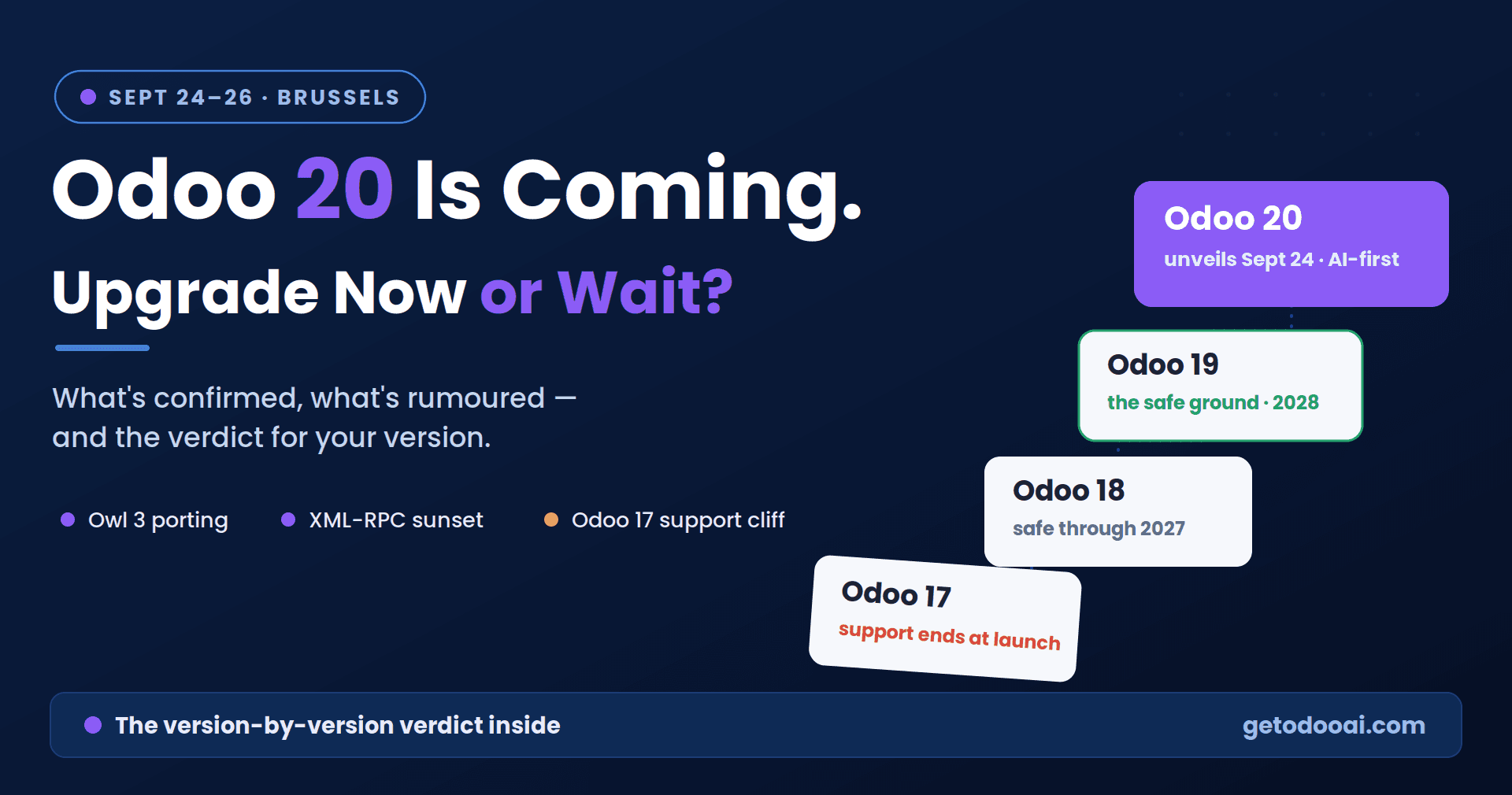
Odoo supports each major version for three years. When Odoo 20 ships, Odoo 17 (released 2023) exits official support: no more security patches, no official migration scripts. Odoo 18 runs through 2027; Odoo 19 through 2028.
An ERP without security patches isn't a neutral "we'll get to it" state. It's your company's financials, inventory, and customer data on software that stops receiving fixes, while the jump to a supported version grows larger with each release you skip, because of Owl 3 porting and the JSON-2 migration stack on top of everything else you've deferred.
Upgrade now or wait: the verdict by version
On Odoo 15 or 16: Upgrade to 19 now. Don't wait for 20. You're already out of support, every quarter adds risk, and jumping straight to a just-launched 20 means crossing the Owl 3 and JSON-2 chasms in one leap on a release nobody has battle-tested. Get to 19, supported through 2028, and evaluate 20 from stable ground.
On Odoo 17: Move to 19 before the cliff. You have until Odoo 20 ships, roughly weeks, not quarters. A 17→19 upgrade uses official scripts and lands you on a version with a JSON-2 API already in place, which turns your future 20 migration into a small step instead of a cliff jump.
On Odoo 18, lightly customised: You can afford to wait. You're supported through 2027. Let Odoo 20's first stable patch land, typically a month or two after launch, and upgrade once the partner ecosystem has validated it in live environments.
On Odoo 19: Wait, but work. You're on the best possible ground, supported through 2028, JSON-2 already available. Spend this quarter inventorying custom frontend components (your Owl 3 porting list) and moving integrations off XML-RPC. When 20 stabilises, your upgrade will be the easy kind.
Heavily customised, any version: The verdict above shifts one notch conservative, and the first step is always the same: a code audit. You can't price a migration you haven't inventoried, and the Owl 3 delta makes this release's inventory matter more than usual.
The bottom line
Odoo 20 looks like a genuinely important release, but "important" and "upgrade immediately" are different words. The winners of this cycle will be the businesses standing on Odoo 19 with clean integrations when 20 stabilises, not the ones leaping onto launch-day software or, worse, riding an unsupported 17 into 2027.